
Quick Answer
Eyelash extensions on straight lashes can be planned successfully when a trained artist evaluates the natural-lash direction, strength, lid space and desired effect. Strong curl is not automatically the best option. The chosen extension needs a compatible base profile, controlled length and clean attachment area, and supplier curl samples should be compared before wholesale ordering.
| Natural-lash observation | Starting comparison | Main question |
|---|---|---|
| Straight and forward | B, C, LC or L samples | Which profile creates lift while preserving workable contact? |
| Straight and downward | C/CC vs LC/L/M samples | Does the curl clear the lid and remain balanced? |
| Fine or sparse | Conservative length and density | Is the complete design suitable for the assessed natural lash? |
| Mixed directions | Zone-by-zone curl planning | Can transitions remain smooth across the map? |
Curl letters are supplier specifications, not universal geometry. Two trays with the same curl name can show different base lengths and lift points, so physical sample comparison is essential.
Table of Contents
- Why natural-lash direction matters
- J/B/C vs L/LC/M profiles
- Contact area and attachment planning
- Mapping straight or downward lashes
- Length and density guardrails
- Curl sample and reorder worksheet
- FAQ
Why Does Natural-Lash Direction Matter?
Natural lashes can point upward, forward, straight or downward, and the direction can change between inner, middle and outer zones. An extension curl that looks attractive on a tray may produce a different result once its base meets the natural lash.
The artist should assess the eye open and closed. Lid space, outer-corner direction and the distance between the lash line and visible fold all affect the final appearance. This is why an eye-shape photo alone cannot select the curl.
Use the Eye Shapes for Lash Extensions guide for the wider consultation, then treat natural-lash direction as a separate product decision.
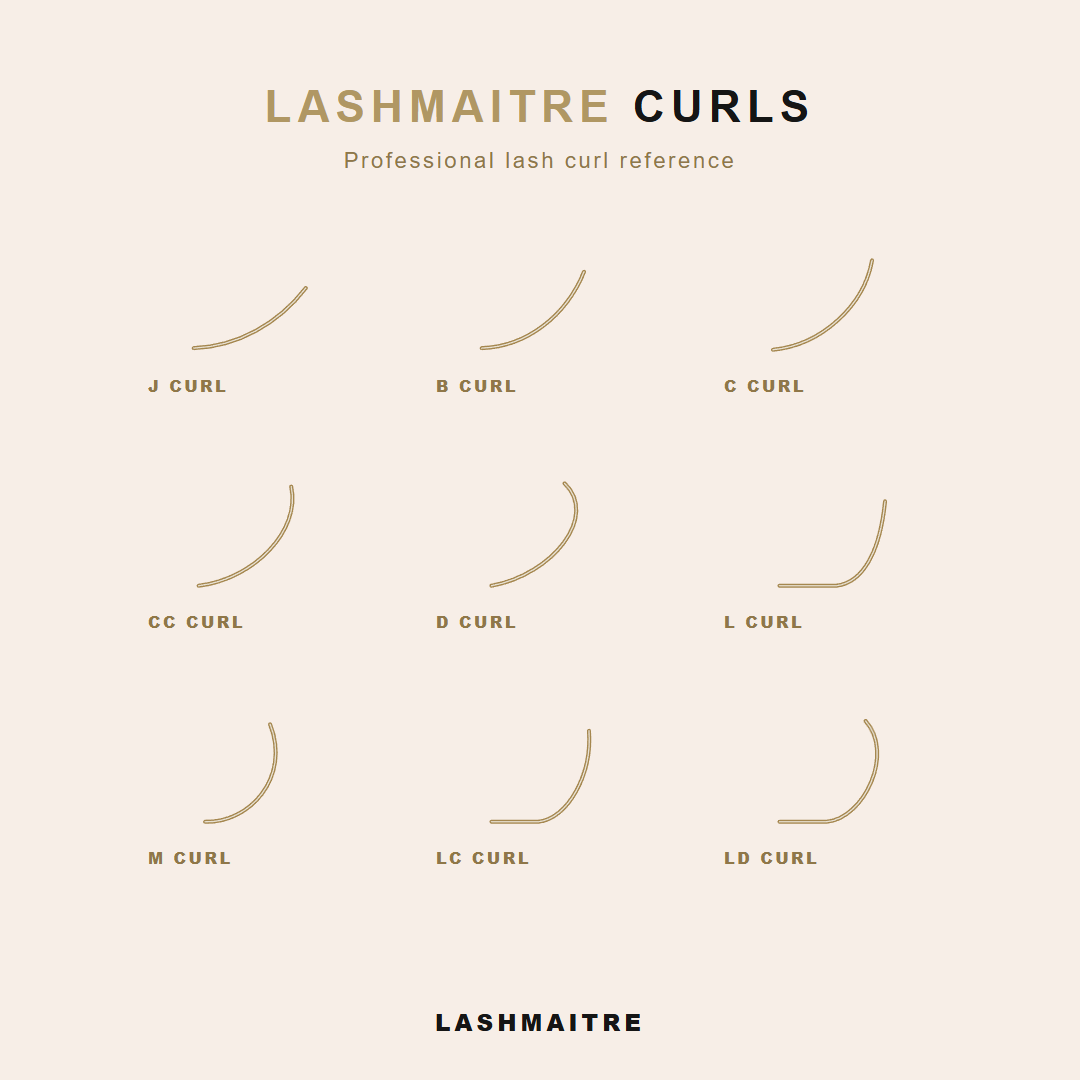
Best Lash Curl for Straight Lashes: J/B/C vs L/LC/M
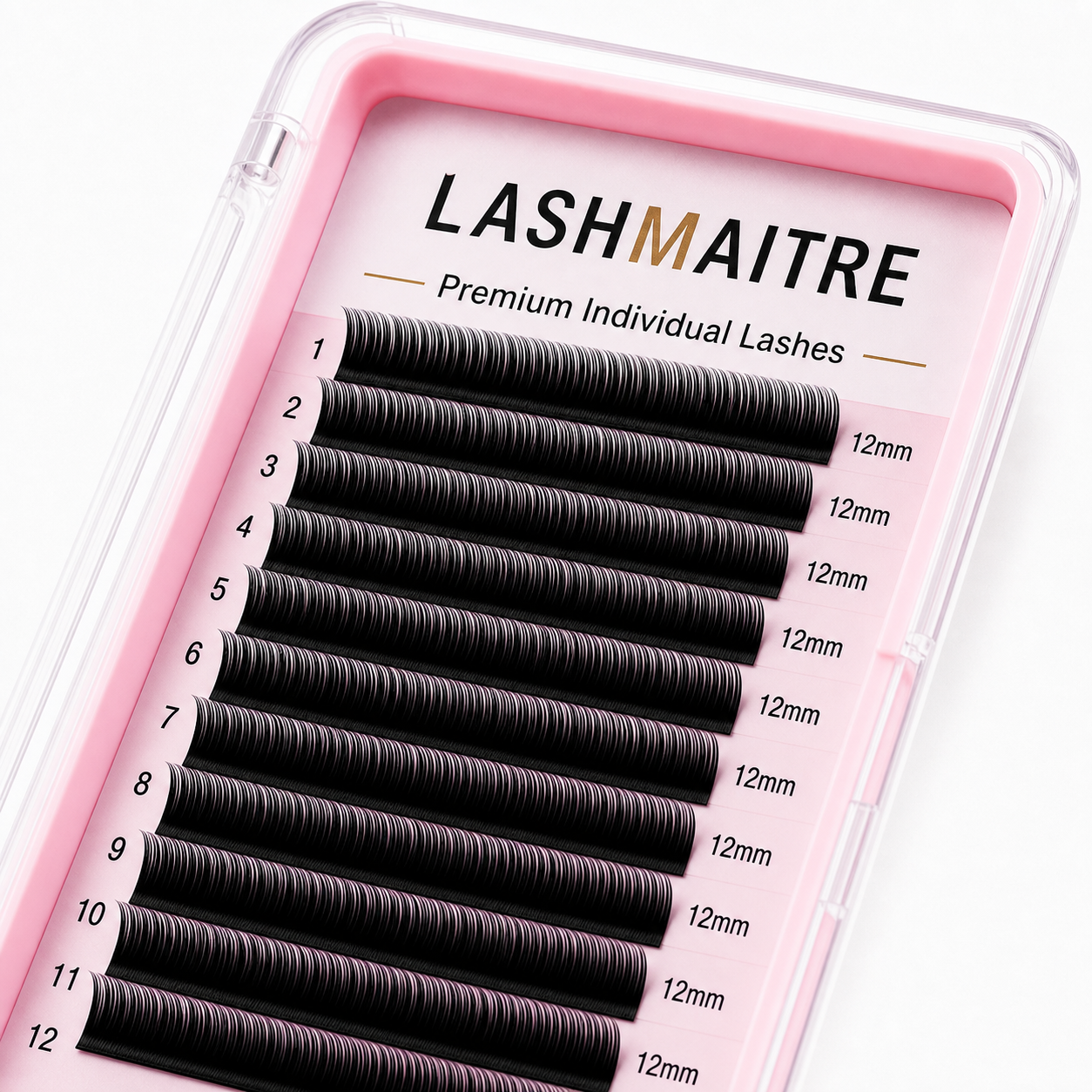
There is no single best lash curl for straight lashes. Standard curls and specialty curls solve different styling problems.
| Curl family | General profile to compare | Useful sample question |
|---|---|---|
| J | Soft curve close to a natural profile | Is the result visible enough for the service goal? |
| B | Gentle lift | Does it add definition without an abrupt transition? |
| C/CC | More visible curved lift | Is there a clean, workable base for the natural direction? |
| L/LC | Straighter base with a more directional lift | Does the lift point suit the lid space and map? |
| M | Distinct specialty profile | Can the artist maintain smooth direction through each zone? |
The J Curl vs B Curl vs C Curl guide explains the standard family. The LC Curl vs L Curl vs M Curl guide compares specialty profiles. Use both as starting references, then inspect the supplier's actual samples. When the choice narrows to rounded D versus directional LD, compare the D Curl vs LD Curl profiles at matched length and diameter.
Contact Area and Attachment Planning
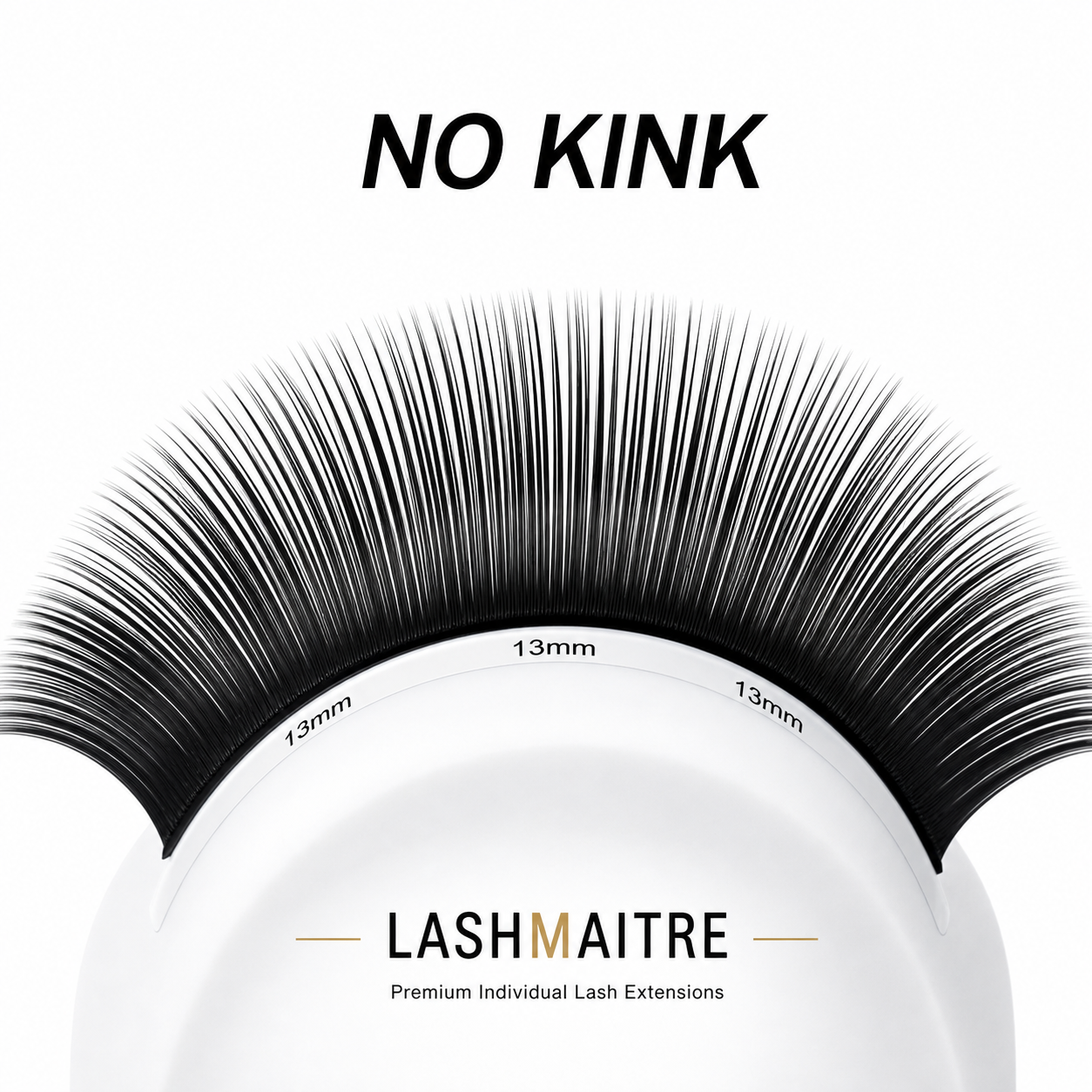
The extension base and the natural lash need a clean, professionally controlled attachment. When a natural lash points straight or downward, an aggressive curl choice can reduce the workable contact area if the profiles do not align. That does not make specialty curls unsuitable; it means the artist must select and place them within training.
Evaluate the base before buying:
- How long is the straight or gently curved base section?
- Where does the visible lift begin?
- Does the profile stay consistent across lengths?
- Can the artist place it cleanly without forcing direction?
- Does the curl transition smoothly beside the neighboring zone?
Avoid prescribing an attachment length or adhesive amount as a universal number. Those decisions depend on product instructions, professional training and the actual lashes being assessed.
Mapping Eyelash Extensions on Straight or Downward Lashes
Start with the desired visual direction, then build a map that the natural lashes can support. Three common starting directions are:
Soft Natural Lift
Use a gradual length transition and compare B, C or an appropriate specialty curl sample. Keep the difference between zones controlled so the set looks cohesive from the front and side.
Open or Center-Lifted Map
Build toward a center or near-center peak, then taper. Check the eye open to confirm that the curl remains visible and does not crowd the lid. The peak should not be copied from a generic chart without adjustment.
Kitten or Lifted Outer Map
Move the peak before the final outer corner and taper the last zone. This can avoid adding the longest fibers to natural lashes that already point downward at the edge. Review the Squirrel Eye Lash Extensions guide for an earlier-peak structure.
Length, Diameter and Density Guardrails
Curl cannot be separated from length and density. A stronger curl may appear shorter from the front because more length is carried in the curve. A longer extension can also change the visual balance and complete design.
For Classic services, compare the approved curl in the Classic Lash Trays range. For lightweight volume directions, compare the same map with appropriate Volume Lash Trays. Do not move from Classic to Volume simply to create more lift; they are different product formats.
For a dedicated specialty-curl option, review the Premium Special Curl Individual Lash Extensions and compare the available curl profile against the salon’s approved sample.
Record the full specification in every test: curl, length, diameter, finish, map zone and product batch. This makes later reorders traceable and helps the salon distinguish a mapping issue from a supplier-profile change.
A Curl Sample and Reorder Worksheet
Test at least three representative lengths—for example 8mm, 11mm and 14mm—because a curl profile may not look identical across the complete range.
| Check | Sample A | Sample B | Approved reference |
|---|---|---|---|
| Curl label and supplier | |||
| Base profile | |||
| Lift point | |||
| Front-view result | |||
| Side-view result | |||
| Inner/middle/outer transition | |||
| Strip release and pickup | |||
| Batch and approval date |
Photograph every sample under the same lighting and camera angle. Keep one physical tray or curl card as the approved reference when possible. On reorder, compare the incoming batch before mixing it into live service stock.
Common Mistakes with Straight-Lash Curl Selection
- Choosing the strongest curl letter without checking the base profile.
- Assuming all suppliers use identical curl geometry.
- Using the same curl in every zone despite mixed natural-lash directions.
- Increasing length to compensate for a map that is not visible from the front.
- Ignoring the outer-corner taper.
- Approving a curl from a tray photo rather than an application sample.
- Failing to record the supplier and batch used in the approved result.
Safety and Professional Scope
Straight natural lashes are not a reason to promise that one curl will be safe or suitable for everyone. Eye-area irritation, allergies and product ingredients require separate screening and professional judgment. The U.S. Food and Drug Administration advises checking adhesive ingredients and stopping use if an eye cosmetic causes irritation. See FDA Eye Cosmetic Safety and FDA Allergens in Cosmetics.
A PubMed Central literature review summarizes reported adverse effects associated with eyelash extensions and supports careful professional application. It should not be used to diagnose a client or to claim that a specific curl prevents reactions. Clients with concerning symptoms should seek appropriate healthcare advice.
FAQ
Can you put eyelash extensions on straight lashes?
Yes, a trained artist can apply eyelash extensions to suitable straight natural lashes after assessing their direction, condition and the eye area. The curl, base profile, length and density must work together. A strong curl should not be selected only because the natural lashes look straight.
What is the best lash curl for straight lashes?
There is no universal best curl. B or C may provide a gradual lift, while LC, L or M may suit some directional goals. The artist should compare actual supplier profiles, workable contact area, lid space and map transitions before choosing a curl for the client.
Are L curl lashes good for straight natural lashes?
L curl can be a useful sample because its straighter base and directional lift may align with some straight-lash maps. It is not automatically correct for every eye. Compare L with LC, M and standard curls, then evaluate attachment, lid clearance and the finished transition.
Should downward lashes always use a stronger curl?
No. Stronger visible curl is only one variable. The artist must also consider the base profile, contact area, length, natural-lash condition and lid space. In some cases, a controlled specialty curl works; in others, a more gradual profile creates a cleaner, more stable-looking map.
How should salons order curl trays for straight-lash services?
Order a small sample range first. Compare at least three lengths in the core curls, photograph results from the front and side, and record supplier and batch details. Expand single-length stock only after the salon identifies repeatable maps and confirms which rows are used most often.
Conclusion
Planning eyelash extensions on straight lashes starts with natural-lash direction, not a curl letter. Compare base profiles, lift points, length transitions and complete designs, then save the approved supplier and batch reference. Browse LASHMAITRE Special Curl Lash Extension Trays and request samples before building a wholesale curl range.
Sources
- FDA Eye Cosmetic Safety, accessed July 19, 2026.
- FDA Allergens in Cosmetics, accessed July 19, 2026.
- Eyelid Cosmetic Enhancements and Their Associated Ocular Adverse Effects, PubMed Central, accessed July 19, 2026.
Plan Your Next Lash Product Direction
Use this guide to brief your salon team or shortlist a sample direction. Then ask LASHMAITRE to confirm tray format, curl, thickness, length mix, packaging and reorder details.
Contact LASHMAITRE for sample support or compare professional lash extension trays.